-
E-mail
2652925775@qq.com
-
Phone
18030056910
-
Address
Yudian Technology Building, No.17 Huoju North Road, Huoju High tech Zone, Xiamen City, Fujian Province
Product Categories
Xiamen Yudian Automation Technology Co., Ltd
Supply PID temperature controller company
NegotiableUpdate on 01/16
- Model
- Nature of the Manufacturer
- Producers
- Product Category
- Place of Origin
Overview
The Xiamen Yudian PID temperature controller is a maintenance free instrument that uses automatic zeroing and digital calibration technology. If it exceeds the tolerance during measurement and calibration, the problem can usually be solved by cleaning and drying the inside of the instrument. If the accuracy cannot be restored by drying and cleaning, the instrument should be treated as a faulty instrument and sent back to the factory for maintenance; Note 2: The instrument can provide free maintenance for 5 years from the date of product manufacturing. For instruments that need to be repaired, please specify the fault phenomenon and cause to ensure correct and comprehensive repair.
Product Details
Xiamen Yudian PID Temperature ControllerTechnical Specifications:
Color |
black, gray |
Work environment: |
0-60 |
|
Measuring range |
-999~9999 |
Customized processing: |
yes |
|
Control output: |
Solid state relay, relay, thyristor, current |
Model: |
AI-518 |
|
Measurement accuracy: |
0.25% |
Brand: |
Xiamen Yudian |
|
Input signal: |
completeinput |
Display mode |
Dual digital tube |
|
Overall dimensions: |
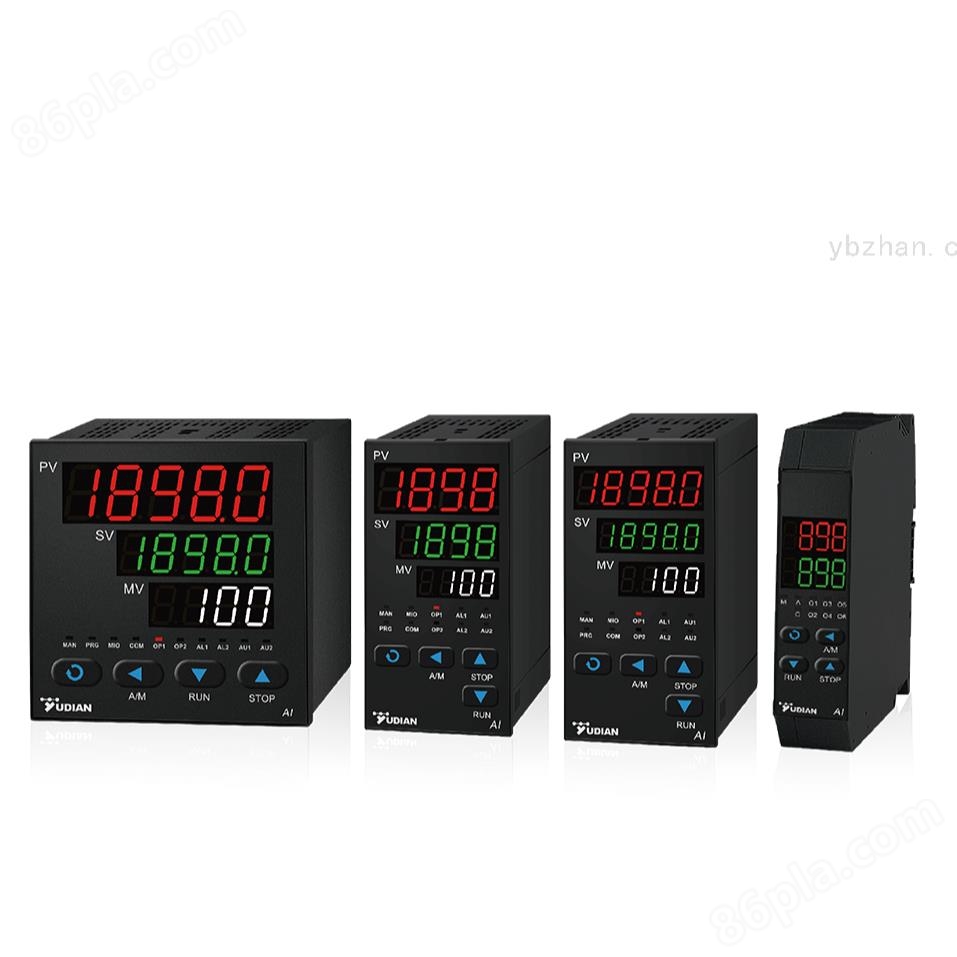
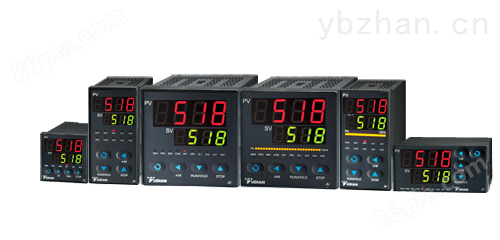
96*96 48*48 96*48 48*96 72*72 160*80 80*160(mm) |
|||
Product features/technical specifications | ||||
|
Xiamen Yudian PID Temperature ControllerProduct Features The input adopts a precise and stable digital calibration system, supporting multiple thermocouple and thermistor specifications, with a maximum resolution of 0.01 ℃. Adopting excellent AI artificial intelligence PID regulation algorithm, without overshoot, with self-tuning (AT) function. Adopting excellent modular structure, providing rich output specifications, it can widely meet the needs of various application scenarios, with fast delivery and easy maintenance. The operation method of humanized design is easy to learn and use. Allow self editing operation permissions and interfaces, and can set passwords to create "customized" instruments. Universal 100-240VAC input range switch power supply or 24VDC power supply, with multiple panel and external dimensions to choose from. The anti-interference performance meets the requirements of electromagnetic compatibility (EMC) under harsh industrial conditions. Precautions This manual introduces the AI-518/518P artificial intelligence PID temperature controller of V8.1. Some of the functions described in this manual may not be suitable for other versions of the instrument. The model and software version number of the instrument will be displayed on the monitor when the instrument is powered on. Users should pay attention to the differences between different models and versions of instruments when using them. Users must carefully read this manual to correctly use and fully utilize the functions of this instrument. AI instruments should have their input and output specifications and functional requirements correctly set before use. Only instruments with configured parameters can be put into use. ------------------------------------------------------------------------------- Xiamen Yudian PID Temperature ControllerTechnical Specifications ● Input specifications (compatible with one instrument): Thermocouples: K, S, R, E, J, T, B, N, WRe3-WRe25, WRe5-WRe26, etc. Thermistors: Cu50, Pt100 Linear voltage: 0~5V, 1~5V, 0~100mV, 0~20 mV, 0~500mV, etc. Linear current (requires external shunt resistor): 0~10mA, 0~20mA, 4~20mA, etc. Expansion specifications: On the basis of retaining the above input specifications, users are allowed an additional input specification (division table may need to be provided) Measurement range: K (-50~+1300 ℃), S (-50~+1700 ℃), R (-50~+1700 ℃), T (-200~+350 ℃), E (0~800 ℃), J (0~1000 ℃), B (200~1800 ℃), N (0~1300 ℃), Cu50 (-50~+150 ℃), Pt100 (-200~+800 ℃) Linear input: -9990~+30000 to be defined by the user Measurement accuracy: 0.25% FS ± 1 measurement unit Sampling period: 8 samples per second; When setting the digital filtering parameter FILt=0, the response time is ≤ 0.5 seconds Control cycle: adjustable from 0.24 to 300.0 seconds ● Adjustment method: Positional adjustment method (adjustable hysteresis) AI artificial intelligence adjustment, including excellent control algorithm with fuzzy logic PID adjustment and parameter self-tuning function ● Output specifications (modular): Relay contact switch output (normally open+normally closed): 250VAC/1A or 30VDC/1A thyristor contactless switch output (normally open or normally closed): 100~240VAC/0.2A (continuous), 2A (20mS instantaneous, repeat period greater than 5S) SSR voltage output: 12VDC/30mA (used to drive SSR solid-state relays) thyristor trigger output: can trigger bidirectional thyristors of 5~500A, 2 unidirectional thyristors connected in anti parallel or thyristor power module linear current output: 0~10mA or 4~20mA can be defined (output voltage ≥ 10.5V when installing X3 module; output voltage ≥ 7V when installing X5 module) ● Jing reporting function: 4 modes including upper limit, lower limit, deviation upper limit, deviation lower limit, etc., with up to 4 output channels, and a power on exemption alarm selection function Electromagnetic compatibility: IEC61000-4-4 (electrical fast transient pulse group), ± 4KV/5KHz; IEC61000-4-5 (Surge), 4KV ● Isolation and voltage resistance: The power supply terminal, relay contacts, and signal terminals are ≥ 2300V between each other; the weak current signal terminals that are isolated from each other are ≥ 600V between each other Power supply: 100~240VAC, -15%,+10%/50~60Hz; 120-240VDC; Or 24VDC/AC, -15%,+10% Power consumption: ≤ 5W ● Operating environment: Temperature -10~60 ℃; Humidity ≤ 90% RH ● Panel dimensions: 96 × 96mm, 160 × 80mm, 80 × 160mm, 48 × 96mm, 96 × 48mm, 48 × 48mm, 72 × 72mm ● Opening size: 92 × 92mm, 152 × 76mm, 76 × 152mm, 45 × 92mm, 92 × 45mm, 45 × 45mm, 68 × 68mm Insertion depth: ≤ 100mm | ||||
Model Definition |
|
The AI series instrument hardware adopts excellent modular design. AI-518/518P instrument allows for the installation of up to 5 modules, including output and reportingjingThe corresponding modules for communication and other functions can be selected according to the needs. The modules can be purchased together with the instrument or separately, and can be freely combined. Xiamen Yudian PID Temperature ControllerThe input methods can be freely set to thermocouple, thermistor, and linear voltage (current). The AI-518/518P instrument model consists of 9 parts, such as AI-518P A N X3 L5 N S4-24VDC - (F2) ① This indicates an instrument: ① The basic function is AI-518P type; ② The panel size is A-type (96 × 96mm); ③ The auxiliary input (MIO) module is not installed; ④ Install a linear current output module for the main output (OUTP); ⑤ ReportjingALM installation of L5 dual relay contact output module; ⑥ Auxiliary output (AUX) does not have a module installed; ⑦ The communication interface (COMM) is equipped with a photoelectric isolation RS485 communication interface S4 with built-in isolation power supply; ⑧ The instrument power supply is a 24VDC power supply; ⑨ Expand input specifications to F2 type (radiation high-temperature thermometer); Below isXiamen Yudian PID Temperature ControllerThe meanings of the 9 parts in the model. ① Indicate the basic function of the instrument AI-518P (adding 30 time program control functions on the basis of AI-518) ② The size specification of the instrument panel A is 96 × 96mm, with an opening of 92 × 92mm and an insertion depth of 100mm. On the basis of A, 25 segments of 4-level brightness light column display function are added. The panel is 96 × 96mm, with an opening of 92 × 92mm and an insertion depth of 100mm. The panel is 160 × 80mm (width × height), horizontal, with an opening of 152 × 76mm and an insertion depth of 100mm. The panel is 80 × 160mm (width × height), vertical, with an opening of 76 × 152mm and an insertion depth of 100mm. On the basis of C, 50 segments of 2-level brightness light column display function are added. The rest are the same as C panel D panel 72 × 72mm, with an opening of 68 × 68mm and an insertion depth of 95mm. D2 panel 48 × 48mm. mm, opening 45 × 45mm, insertion depth of 95mm D6 panel 48 × 48mm, opening 45 × 45mm, insertion depth of 95mm E panel 48 × 96mm (width × height), opening 45 × 92mm, insertion depth of 100mmE2 adds 25 segments of 4-level brightness light column display function on the basis of E, panel 48 × 96 mm, Opening 45 × 92mm, insertion depth of 100mm, size 48 × 96 (width × height), DIN rail installation mode, can be set and operated by external E8 keyboard and monitor, F panel 96 × 48mm (width × height), opening 92 × 45mm, insertion depth of 100mm ③ Module specifications for instrument auxiliary input (MIO) installation: I2, I4, K3, V and other modules can be installed, N indicates no installation, the same applies below. ④ Module specifications for the installation of instrument main output (OUTP): L1, L2, L4, W1, W2, G, K1, K3, X3, X5 and other modules can be installed. ⑤ Indicate instrument reportjingModule specifications for ALM installation: L0, L2, L4, L5, W1, W2, G and other modules can be installed. ⑥ Module specifications for instrument auxiliary output (AUX) installation: L0, L1, L2, L4, L5, W1, W2, G, K1, X3, X5 and other modules can be installed. ⑦ Module specifications for instrument communication (COMM) installation: S, S4, V, and other modules can be installed. ⑧ Indicating instrument power supply: Not written indicates the use of 100-240VAC power supply, 24VDC indicates the use of 20-32VDC or AC power supply. ⑨ The AI-518/518P has stored commonly used thermocouple and thermistor input specifications (see technical specifications below), indicating the specifications of the scale table for instrument expansion (if not available, do not write them). However, if input signals other than the above specifications are used, users are allowed to expand one input specification. Note 1:Xiamen Yudian PID Temperature ControllerMaintenance free instruments that use automatic zeroing and digital calibration technology. If they exceed the tolerance during metrological verification, cleaning and drying the inside of the instrument can usually solve the problem. If the accuracy cannot be restored by drying and cleaning, the instrument should be treated as a faulty instrument and sent back to the factory for maintenance; Note 2: The instrument can provide free maintenance for 5 years from the date of product manufacturing. For instruments that need to be repaired, please specify the fault phenomenon and cause to ensure correct and comprehensive repair. |
Module Description |
|
● Common modules N (or not written) does not have a module installed. L0 large volume and large capacity relay contact switch output module (module capacity: 250VAC/2A, suitable for reporting)jingUse). L1 large capacity relay (domestic Hongfa 8A/250VAC) normally open contact switch output module (module capacity: 250VAC/2A). L2 relay normally open+normally closed contact switch output module (module capacity: 30VDC/1A, 250VAC/1A, suitable for reporting)jingUse). L4 large capacity relay (imported brand 8A/250VAC) normally open contact switch output module (module capacity: 250VAC/2A). L5 dual relay (Panasonic NAIS 5A/250VAC) normally open contact switch output module (capacity: 30VDC/2A, 250VAC/2A). W1 and W2 thyristor non-contact normally open (W2 is normally closed) output module (capacity: 100~240VAC/0.2A, with the characteristic of "not burning out"). G solid-state relay drive voltage output module (12VDC/30mA). G5 dual channel solid-state relay driving voltage output module. K1/K3 single/three-way "burnable" thyristor zero crossing trigger output module (each can trigger 5-500A bidirectional or two anti parallel unidirectional thyristors). K5/K6 single channel 220VAC/380VAC "burnable" single channel thyristor phase-shift trigger output module (can trigger 5-500A bidirectional or two anti parallel unidirectional thyristors). X3 photoelectric isolated programmable linear current output module. X5 has a photoelectric isolation programmable linear current output module with an isolated power supply. S photoelectric isolation RS485 communication interface module. S1 photoelectric isolation RS485 communication interface module (using internal 24V isolation power supply of the instrument). S4 is a photoelectric isolation RS485 communication interface module with built-in isolation power supply. RS232C communication interface module with R photoelectric isolation. 24V/12V/10V DC voltage output isolated from V24/V12/V10, suitable for external transmitters or other circuits, with a maximum current of 50mA. I2 switch quantity/frequency signal input interface, can be used for external switch contacts or frequency signal input, including 12VDC power output for external sensors. I4 analog 4-20mA/0-20mA input interface, including 24VDC/25mA power output for two-wire transmitters. RS485 communication strip with single relay normally open contact output module for SL D6 specification optoelectronic isolation, communication uses internal 12VDC power supply of the instrument L6 D6 specification three-way relay normally open contact output module. ● Module installation and replacement module According to the user's requirements at the time of ordering, the instrument can be installed and the corresponding parameters can be set correctly before delivery. If the module is damaged or needs to be changed in function, users can also replace the module themselves. When replacing the module, the instrument core can be pulled out and carefully pried open at the joint between the original module and the motherboard socket with a small flathead screwdriver. Remove the original module and then install the new module according to the markings. If the type of module changes, it is often necessary to modify the corresponding parameter settings. ● Electrical isolation of modules The instrument has one set of 24V and one set of 12V power supplies that are isolated from the main circuit for module use. The 24V power supply is usually used for voltage output modules, such as V24/V12/V10 (24V/12V/10V voltage output), I2 (frequency/switch input, whose 12V output voltage can be isolated), or I4. 12V power supply for output and communication module use; Relays and thyristor triggered output modules usually have their own isolation or do not require the use of an isolation power supply, so the main consideration is the isolation between the communication interface and the current output. S (RS485 communication interface), R (RS232 communication interface), X3 (linear current output), and their input and output terminals are electrically isolated from the instrument input circuit, that is, the main line. However, these modules all require the use of the 12V isolation power supply provided inside the instrument. If the user installs both modules with isolation functions at the same time, these two modules cannot be electrically isolated from each other because they share the power supply of the isolation part. New modules such as S4 (RS485 communication interface) and X5 (linear current output) have been designed for this purpose, which come with high-efficiency DC/DC power isolation converters and do not occupy the internal isolation power supply of the instrument. For example, if the X3 module is installed at the main output (OUTP) position of the instrument, and the S or X3 module is installed on the communication interface (COMM), the X3 module cannot be isolated from the S or X3 module, and the S4 or X5 module should be installed. For relay contact output and thyristor contactless switch output, they are isolated from other circuits and are not limited by the installation of other modules; The SSR voltage output module (G module) generally does not require additional isolation, as typical SSRs themselves have isolation functions. ● Application instructions for some modules Voltage output modules: Power output modules such as V24, V10, and V12 typically provide power to external sensors and transmitter feedback resistors. These modules can be installed on any module socket, but to ensure proper wiring, it is recommended to install them in the MIO, AUX, and COMM positions in sequence based on their availability. Contactless switch module: W1/W2 is a new type of contactless switch module designed with excellent "burn out" protection technology and zero crossing connection technology. It can replace the commonly used relay contact switch output for controlling servo motors of AC contactors or electric actuators. Compared with relay contact output modules, it has the advantages of long service life and can greatly reduce equipment interference sparks, which can greatly improve system reliability. The driving component of the contactless switch is a thyristor, so it is only suitable for controlling AC power with a specification of 100-240VAC, and cannot be used for controlling DC power. Due to the series connection of protective devices at the output end, the maximum continuous control current is 0.2A, and the instantaneous current is allowed to reach 2A. This driving capability can directly control AC contactors below 220AC and 80A, but for larger loads, intermediate relays need to be added. Relay module: Relay module is a widely used output module in industrial control, but it is also one of the modules with limited service life and height. In addition, relay action often brings a lot of electromagnetic interference, so it is very important to choose the correct relay module. Control the output of mechanical switches such as contactors and solenoid valves powered by 220VAC. It is recommended to use the W1 module. If the control is DC or AC power above 50VAC, only relay modules can be used, and modules such as L1 and L4 can be used. The L2 module is a small volume module with no volume limitation issues, and it has both normally open and normally closed contacts with varistor spark absorption function. However, the contact capacity is small, making it suitable for reportingjingOutput. L1 and L5 are relay modules with large volume and capacity. These modules cannot be installed on the main board or side board at the same time in instruments with a width of 48mm (including sizes D2, E, F, E5, etc.), otherwise they will collide. Therefore, when installing L1 or L5 on one side, the other side cannot be installed with the output module. L5 is a dual relay module with *, which can be used for 2-channel alarm outputs, such as AL1+AL2. If you do not like mechanical contacts or cannot install due to height restrictions, you can choose G5 (SSR voltage) external solid-state relay (SSR) to drive the load. |
Similar Product Recommend