-
E-mail
geqianshun@vip.sina.com
-
Phone
18913397620,13951770588
-
Address
Chenggong Industrial Park, Lukou Town, Jiangning District, Nanjing City
Product Categories
Nanjing Shengchi Rubber Machinery Manufacturing Co., Ltd
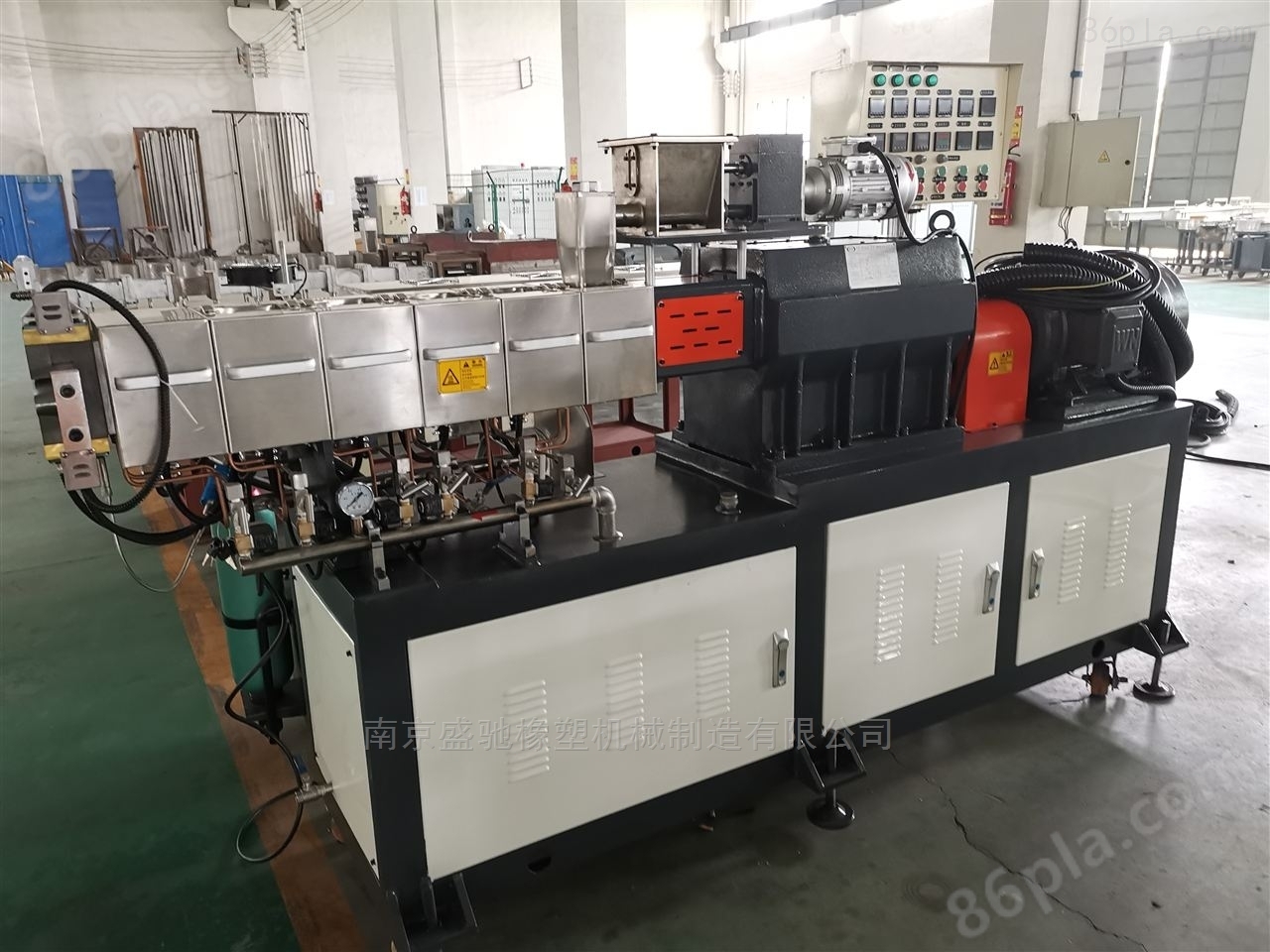
Industrial twin-screw water-cooled granulator
NegotiableUpdate on 01/23
- Model
- Nature of the Manufacturer
- Producers
- Product Category
- Place of Origin
Overview
Industrial twin-screw water-cooled granulators are widely used in light industry, chemical industry, electronics, textile, medical, automotive, construction, building materials, national defense, aerospace, aviation and other fields.
Product Details
Industrial twin-screw water-cooled granulatorCharacteristics:
1. Compulsory feeding hopper is used for feeding, with uniform cutting, saving manpower, and high output.
2. Electromagnetic induction heating is applied to the feeding port and melting section of the server, and both plastic pellets and water can be granulated.
3. The extruder screw is carefully designed for product research and development, and the entire machinery and various components are effectively equipped. The route uses three flames and one zero heating.
4. The overall mechanical equipment has been increased, improving the service life of the machinery and equipment.
5. The granulator has the characteristics of high output and energy-saving, equipped with a large torque reducer and motor.
6. High quality electrical equipment and drive machinery make mechanical equipment more reliable in applications.
Operation method of industrial twin-screw water-cooled granulator:
1. Before starting up, first raise the temperature for about forty to fifty minutes. Raise the temperature to the point where you can manually pull the triangular belt of the motor until it feels comfortable; Pull continuously in the normal working direction for eight to ten times. Then continue to heat up for about ten minutes, and then turn on the machine, but continue to heat up because normal production requires continuous replenishment of heat;
Adjust the temperature according to the different properties of plastics.
2. When the granulator is working normally, the machine temperature should be kept stable and not fluctuate rapidly. Near the vent hole, the temperature of the machine head should be maintained at around 200 ℃ (referring to material C and material B).
3. The feeding should be uniform and there should be no shortage of materials. The feeding speed and feeding speed of the machine should be coordinated appropriately. Otherwise, it will affect the quality and yield of the particles.
4. When shutting down, the host must cut off the power supply. The head plug (with wrench) must be removed. Preheat separately before the next use.
In the process of using an air-cooled hot cutting granulator, paying attention to the above related operation matters can not only improve the safety of the operation, but also further improve the work efficiency and ensure the smooth progress of the work.
Double screw water-cooled granulatorCommon faults:
The common faults of twin-screw granulators include the inability of the main motor to start, abnormal noise from the main motor, unstable main motor current, and poor or blocked discharge from the machine head. The following is a detailed analysis and introduction.
1. The main motor cannot start
Cause: There is an error in the driving program. There is a problem with the main motor thread, is the fuse burnt.
Solution: Check the program to restart in the correct driving sequence, check the main motor circuit, check if the lubricating oil pump is started, and check the status of the interlock devices related to the main motor.
2. The main motor emits an abnormal sound
Cause: Damaged main motor bearings. One of the thyristors in the rectifier circuit of the main motor is damaged.
Solution: Replace the main motor bearings. Check the thyristor rectifier circuit and replace the thyristor components if necessary.
3. The host current is unstable
Causes: Uneven feeding, damage or poor lubrication of the main motor bearings, malfunction of a certain section of the heater, failure to heat, incorrect screw adjustment pad or phase, component interference.
Solution: Check the feeder and troubleshoot. Repair the main motor and replace the bearings if necessary. Check if each heater is working properly and replace it if necessary.
4. The temperature rise of the main motor bearing is too high
Cause: Poor lubrication of bearings. The bearings are severely worn.
Solution: Check and add lubricant. Check the motor bearings and replace them if necessary.
5. The discharge of the machine head is not smooth or blocked
Cause: A certain section of the heater is not working, resulting in poor plasticization of the material. The operating temperature is set too low, or the molecular weight distribution of the plastic is wide and unstable. There may be foreign objects that are not easily melted.
Solution: Check the heater and replace it if necessary. Verify the temperature settings for each section and consult with the process engineer if necessary to increase the temperature settings. Clean and inspect the extrusion system and machine head.
6. The starting current of the main power is too high
Cause: Insufficient heating time and high torque. A certain section of the heater is not working.
Solution: When driving, use a hand crank. If it is not easy, extend the heating time or check if each section of the heater is working properly.
9. Heating should be divided into sections, and the segmented heating should be uniform and controllable
10. There should be a matching waste plastic cleaning machine that uses circulating water and does not require the discharge of sewage
11. Efficient and energy-saving
12. The aspect ratio of the machine should be reasonable (the screw length is a multiple of the screw diameter)
13. The larger the model, the higher the output
14. We need dual exhausts
15. The heating power of the granulator flange (die) is very important and should be designed at 2.5W per square centimeter (cross-sectional area)
Similar Product Recommend