-
E-mail
kindlift@163.com
-
Phone
13671771943
-
Address
398 Shengang Road, Shanghai
Product Categories
Qianli (Shanghai) Intelligent System Equipment Co., Ltd
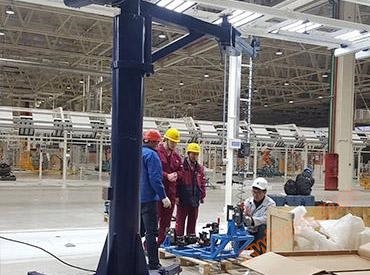
Folding arm crane hoist
NegotiableUpdate on 10/18
- Model
- Nature of the Manufacturer
- Producers
- Product Category
- Place of Origin
Overview
Folding arm crane hoist is a large mechanical equipment that transports by changing the potential energy, such as mine hoist, dam crossing hoist, etc. Generally speaking, elevators, overhead cranes, hoists, stabilizers, cranes, and hoists can all be called elevators. Elevators generally refer to large mechanical equipment with high power and strong lifting capacity ..
Product Details
Elevators are large mechanical equipment that transport by changing the potential energy, such as mine hoists, dam crossing hoists, etc. Generally speaking, elevators, overhead cranes, hoists, stabilizers, cranes, and hoists can all be called elevators. Elevators generally refer to large mechanical equipment with high power and strong lifting capacity. The transportation process is completed by dragging the flexible steel wire rope and the transported goods up and down through power machinery. Steel wire rope is an indispensable and important part of lifting machinery, and the main varieties include phosphating coated steel wire rope, galvanized steel wire rope, stainless steel wire rope, smooth steel wire rope, etc.
Basic Introduction
Bucket elevator is a fixed mechanical conveying equipment, mainly suitable for continuous vertical lifting of powdery, granular and small materials. It can be widely used in various scales of feed mills, flour mills, rice mills, oil mills, starch mills, as well as grain depots, port terminals, etc. for lifting loose materials.
The bucket elevator is used to vertically lift block and granular materials such as limestone, coal, gypsum, clinker, dry clay, as well as powdered materials such as raw materials, cement, and coal powder that have passed through the crusher. According to the speed of the hopper operation, bucket elevators can be divided into three forms: centrifugal unloading, gravity unloading, and mixed unloading. Centrifugal unloading has a fast bucket speed and is suitable for conveying materials with low grinding properties such as powder, granular, and small pieces; The bucket speed of gravity unloading is slow, suitable for conveying block shaped, high specific gravity, and highly abrasive materials such as limestone and clinker. The traction components of bucket elevators include ring chains, plate chains, and adhesive tapes. The structure and manufacturing of the chain are relatively simple, and the connection with the hopper is also very firm. When conveying materials with high abrasiveness, the wear of the chain is small, but its own weight is large. The plate chain structure is relatively sturdy and has a light weight, making it suitable for elevators with large lifting capacity. However, the hinged joints are prone to wear, and the structure of the adhesive tape is relatively simple, but it is not suitable for conveying materials with high abrasiveness. The temperature of ordinary adhesive tape materials does not exceed 60 ℃, the allowable temperature for steel rope tape is 80 ℃, the allowable temperature for heat-resistant tape is 120 ℃, and the temperature for conveying materials with loop chains and plate chains can reach 250 ℃.
Scope of Application
This series of bucket elevators is suitable for conveying non abrasive and low abrasive materials such as coal, cement, stones, sand, clay, ore, etc. in powder, granular, and small pieces. Due to the traction mechanism of the elevator being a circular chain, it is allowed to transport materials with higher temperatures (material temperature not exceeding 250 ℃). The maximum conveying height can generally reach 40 meters.
function
This type of lifting equipment has significant advantages such as large conveying capacity, high lifting height, stable and reliable operation, and long service life. Its main performance and parameters comply with the "Vertical Bucket Elevator" (JB3926-85) (which is equivalent to international standards and advanced foreign standards), and the traction ring chain complies with the "High Strength Ring Chain for Mining" (MT36-80). This elevator is suitable for conveying powders, so it allows for the transportation of materials with higher temperatures.
feature
drive power
Low driving power, using inflow feeding, induction unloading, and dense layout of large capacity hoppers There is almost no material return or excavation during material lifting, so there is less ineffective power.
Increase scope
The lifting range is wide, and this type of lifting machine has fewer requirements for the types and characteristics of materials. It can not only lift general powder and small granular materials, but also improve materials with high grindability Good sealing and minimal environmental pollution.
Operational capability
Good operational reliability, advanced design principles and processing methods ensure the reliability of the entire machine, with a fault free time exceeding 20000 hours. Raise the height high The hoist runs smoothly, so it can achieve a high lifting height.
service life
Long service life, the feeding of the elevator adopts an inflow type, without the need for digging with a bucket, and there is little squeezing and collision between materials. This machine is designed to ensure that materials are less scattered during feeding and unloading, reducing mechanical wear and tear.
working principle
The hopper scoops up the material from the storage below, and as the conveyor belt or chain lifts it to the top, it flips down after passing around the top wheel. The bucket elevator pours the material into the receiving trough. The transmission belt of a bucket elevator with belt drive is generally made of rubber belt, which is installed on the lower or upper transmission drum and the upper and lower reversing drums. A bucket elevator with chain drive is generally equipped with two parallel drive chains, with a pair of drive sprockets on the top or bottom and a pair of reversing sprockets on the bottom or top. Bucket elevators are generally equipped with a casing to prevent dust from flying in the bucket elevator.
structure
Initial components
Assemble the upper casing, active shaft components, reducer, coupling, motor, etc. into one unit.
Central chassis
According to the height that needs to be raised and the configuration of different numbers of middle chassis stacked together, it can meet the needs.
Lower components
Integrated by the bottom casing, driven shaft components, and tensioning device. There is a door on the side of the casing that can be opened for internal inspection such as cleaning.
Chain and hopper
The chain is a welded circular steel chain. The hopper is fixed on the joint of the chain with a nut. Different heights of bucket elevators are equipped with corresponding numbers of chains, joints, and hoppers.