-
E-mail
kindlift@163.com
-
Phone
13671771943
-
Address
398 Shengang Road, Shanghai
Product Categories
Qianli (Shanghai) Intelligent System Equipment Co., Ltd

Column type cantilever crane
NegotiableUpdate on 10/18
- Model
- Nature of the Manufacturer
- Producers
- Product Category
- Place of Origin
Overview
The lifting mechanism and operating mechanism of domestically produced small tonnage cranes with column cantilever cranes rarely use wire rope electric hoists and chain hoists. Rotating and horizontal movement operations are mostly done manually, and only when lifting heavy loads are electric. ...
Product Details
Column type cantilever crane
Column type cantilever cranes often use electric chain hoists as lifting devicesDomestic small tonnage craneThe lifting mechanism and operating mechanism rarely use wire rope electric hoists and chain hoists. Rotation and horizontal movement operations are mostly done manually, only when the lifting weight is largeOnly then did electric power be adopted.
② A wall mounted crane is a cantilever crane fixed to a wall, or a cantilever crane that can run along an elevated track on a wall or other supporting structure.
The use of wall mounted cranes is in workshops or warehouses with large spans and building heights, and is most suitable for frequent lifting operations near walls. Wall mounted cranes are often used in conjunction with beam or bridge cranes above, serving a rectangular space near the wall and responsible for lifting light and small objects, while large items are handled by beam or bridge cranes.
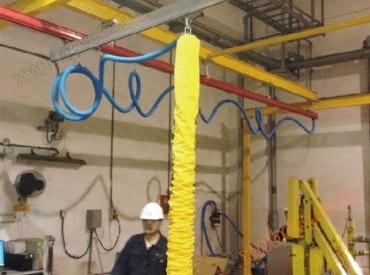
③ A balanced crane, commonly known as a balance crane, uses the principle of a four-bar linkage mechanism to form a balance system between the load and the balance weight. It can flexibly and easily lift loads in three-dimensional space using various lifting devices. The balanced crane is lightweight and flexible, making it an ideal lifting equipment for lifting small items. It is widely used for loading and unloading machine tools in factory workshops, lifting workpieces and sand boxes between processes, automatic lines, production lines, component assembly, as well as various occasions such as stations, docks, and warehouses
Balanced suspension
3. Portal crane
Portal cranes are generally classified according to their gantry structure, main beam form, and lifting device form.
Classified by door frame structure form
(a) Full door crane: The main beam has no overhang, and the trolley operates within the main span.
(b) Semi gantry crane: The legs have a height difference, which can be determined according to the civil engineering requirements of the site of use.
(c) Double cantilever gantry crane: the most common structural form, with reasonable stress distribution and effective utilization of site area.
(d) Single cantilever gantry crane: This structural form is often chosen due to site limitations.
Divided by the structural form of the main beam
(a) Single girder gantry crane
The single main beam cantilever gantry crane has a simple structure, easy manufacturing and installation, and a small self weight. The main beam is mostly a skewed rail box frame structure. Compared with double girder gantry cranes, the overall stiffness is weaker. Therefore, when the lifting capacity Q is ≤ 50t and the span S is ≤ 35m, this form can be used The single main gantry crane has two types of gantry legs: L-shaped and C-shaped The L-shaped design is easy to manufacture and install, with good stress conditions and relatively small weight. However, the space for lifting goods through the support legs is relatively small The C-shaped legs are designed to be inclined or curved, with the aim of providing ample lateral space for goods to pass smoothly through the legs.
(b) Double beam bridge crane
The double girder bridge crane has strong bearing capacity, large span, good overall stability, and a variety of types. However, its own weight is larger than that of a single main girder gantry crane with the same lifting capacity, and the cost is also higher. According to the different structures of the main beam, it can be divided into two forms: box girder and truss. Currently, box shaped structures are commonly used.