-
E-mail
109227595@qq.com
- Phone
-
Address
New Industrial Park, Hong'an County Economic Development Zone, Hubei Province
Product Categories
Hubei Jinma Plastic Industry Co., Ltd
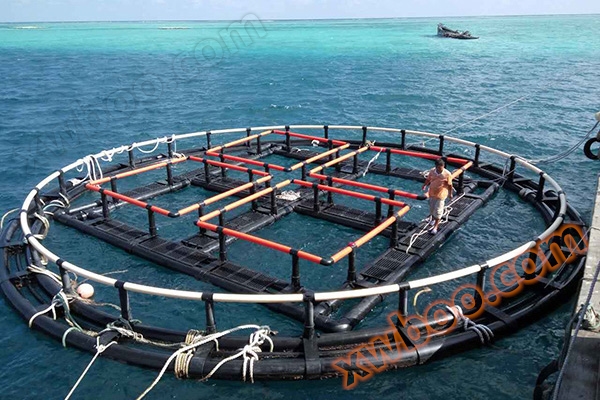
Circular deepwater net cage
NegotiableUpdate on 04/13
- Model
- Nature of the Manufacturer
- Producers
- Product Category
- Place of Origin
Overview
Detailed introduction 1. Basic definition of deepwater net cage "There is currently no strict definition and academic classification of" deepwater net cage ", and there is no unified name at home and abroad
Product Details
- Details
-
1. Basic definition of deepwater net cage
There is currently no strict definition and academic classification for "deepwater net cage", and there is no unified name at home and abroad.
The term 'deepwater' is not a definition used in oceanography to distinguish water depth, nor is it a definition used in marine fishing to divide fishery waters. It is a vague concept compared to ordinary (traditional) cage aquaculture in bays.
Deep water net cage aquaculture areas are located in open or semi open sea areas deeper than 15m, with deeper water and farther offshore compared to areas where ordinary (traditional) net cage aquaculture is carried out in bays. This type of net cage is commonly referred to as deep water net cages. Of course, with the current structural equipment and aquaculture technology of deepwater net cages, it is completely feasible to conduct net cage aquaculture in the water depth area defined in oceanography or marine fishing.
With the gradual maturity of China's deepwater net cage aquaculture technology and the increasing exchange of technology with foreign counterparts, the definition of deepwater net cages has become increasingly clear. Although they are of the same type of net cage in foreign countries, some are called "sea cage", "coastal cage", and "offshore cage". Due to the different marine environments in foreign countries, such as Norway's "fjord", the water depth can reach tens of meters or even deeper if it is less than a hundred meters offshore, while in China's Liaodong Bay, even if it is tens of kilometers or even hundreds of kilometers offshore, the water depth is only 40-50 meters. In China, there are also terms such as "deep-water net cage", "deep-water anti wind and wave net cage", "large-scale anti wind and wave deep-water net cage", "deep-sea net cage", "anti wind and wave deep-sea net cage" for deep-water net cages, which basically refer to... The same type of net cage, with only slight differences in structure or size, is now commonly referred to as a deep-water net cage.
Deepwater net cages have been officially included in the national fishery statistics category based on water bodies and aquaculture methods since 2004. Therefore, the main technical features of the basic definition of deep-water net cages commonly used in China are as follows.
(1) Deep water net cage refers to an open sea area in the open sea, where frames, nets, auxiliary fishing gear and facilities are assembled into net cages with strong wind and wave resistance, and fish or other organisms are kept in captivity. The net cage operated in this way and in the open sea area is called a deep-water net cage.
(2) The commonly referred to open sea areas refer to areas with a depth of up to 15m or deeper that are unprotected and exposed to any form of natural forces, especially those related to storms such as wind waves and currents; The function of deepwater net cages is to create an artificially enclosed space in such open sea areas and keep the cultured organisms within this space, while closely connecting the enclosed space with the surrounding environment. The cultured organisms are controlled artificially and profit from the non natural aquatic ecosystem.
(3) Single box aquaculture surrounds a water body of more than 500m, which is in line with the industrial aquaculture model and has potential for automated and mechanized aquaculture expansion functions.
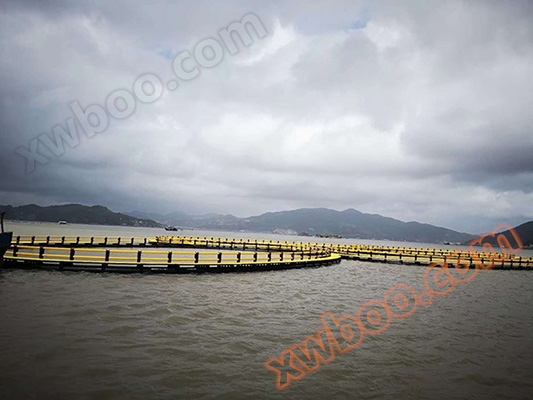

2. HDPE circular double floating pipe floating deep-water net cage
The difference between HDPE circular double floating pipe floating deep-water net cage and HDPE circular double floating pipe lifting deep-water net cage is that they cannot be lifted or lowered. Due to its inability to withstand adverse weather conditions by diving into a customized safe water layer when high sea conditions are about to occur, this deep-water net cage relies entirely on its own structural safety and temporary measures to achieve disaster prevention and mitigation. This type of net cage must attach great importance to the safety risk assessment of open sea areas, with a focus on reviewing the frequency and wave levels of typhoons that have occurred in the area in history, and seeking effective measures for risk prevention from a design perspective.
At present, this type of net cage accounts for more than 90% in China, and most of them are set up in sea areas with certain barriers and protection along the direction of typhoon movement. According to the characteristics of HDPE pipes, circular frames have good wind and wave resistance. Even if the net cage is exposed to a level 12 typhoon, the frame still has good mechanical stability. However, captive objects may suffer losses due to strong impacts in shallow water layers.
The early HDPE circular double floating pipe floating deepwater net cage had a frame circumference of generally 40m and a pipe diameter of 250mm. In recent years, it has gradually expanded to a circumference of over 60m and a pipe diameter of 315mm. From a mechanical perspective and combined with aquaculture conditions, a general net cage circumference of 60-80m is more suitable for China's marine areas. As shown in Figure 1-6, it is a set of HDPE circular double floating pipe floating deep-water net cages. The main technical parameters of HDPE circular double floating pipe floating deep-water net cage are shown in Table 1-3.
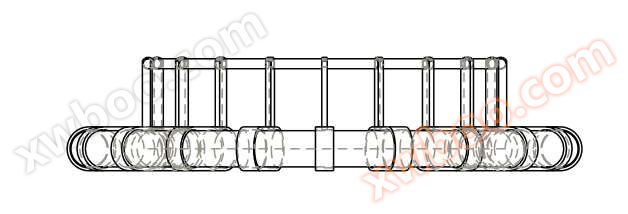
Table 1-3 Main Technical Parameters of HDPE Circular Double Floating Pipe Floating Deep Water Cage
Net cage model
HDPE C40-60/250 HDPE C6O-100/315 HDPE C100-160/400 Net cage floating pipe diameter (mm)
250
315 400 Net cage circumference (m)
40~60 60~100 90~160 Net cage diameter (m)
19~19 19~32 29~51 Double floating tube center distance (cm)
52/66 66 85 HDPE injection molding I-frame
correct correct correct Bracket gauge distance (m)
2~2.5 2~2.5 2.5 Diameter of I-frame column (mm)
125 125 160 Handrail diameter (mm)
110 110 140 Net clothes hook
Optional Optional Optional Floating pipe foam filling
Optional, inner tube Optional, inner tube Optional, inner tube Strengthen the chain
Optional, between two floating pipes Optional, between two floating pipes Optional, between two floating pipes HDPE strength
80~100 80~100 80~100 Product Certification
ISO9001:2000 ISO9001:2000 ISO9001:2000 Number of floating pipes
2 2 2 pedal
Standard configuration, optional Standard configuration, optional Standard configuration, optional Typhoon resistance level
Level 12, can be designed Level 14, can be designed Level 14, can be designed Normal service life
Over 15 years Over 15 years Over 15 years Surrounding water body for aquaculture (m3)
600~1700 1700~8000 7000~20000
The staggered mooring system of HDPE circular double floating pipe floating deep-water net cage is relatively simple. A more scientific mooring system is based on the layout of the underwater net format of the lifting deepwater net cage, as shown in Figure 1-7.

The more economical and practical anchoring system is the two common types of wooden column anchors or concrete anchors in some sea areas within a depth of 20 meters, while meeting the anchoring force required by the net cage aquaculture system.
According to the design of the anchoring system, the combination of floating deep-water net cage groups is also different. The cost of the net format anchoring system is relatively high, and the force on the net cage is relatively independent, making it less prone to mass damage. However, the design of other anchoring systems mostly involves direct connection between net cages, and the force on each net cage will be influenced by the interaction of the entire group of net cages. When a huge resistance is concentrated at a certain point, causing damage to one net cage, other net cages will immediately lose their mutual reliance and support and be in a high-risk state. In addition, two cages that are too close to each other are not conducive to water exchange, and the action of water flow may also cause entanglement and damage between the nets of adjacent cages. Therefore, if a net format anchoring system is not used, sufficient distance should be maintained between adjacent two net cages.