


09,17,2026 5 views
PVCThe performance of a product is influenced by multiple factors, which often take effect before extrusion or molding. As formula requirements continue to evolve and production environments become increasingly complex, upstream processes such as material handling, feeding, blending, and process control play an increasingly important role in achieving stable and consistent production results.
The stability of upstream processes is crucial for ensuring the consistency of PVC product performance.
The increase in complexity of PVC production
Due to its durability, versatility, and cost advantages in fields such as construction, healthcare, consumer goods, and industrial systems, PVC remains one of the most widely used thermoplastic materials.
Although PVC has a long history of application, modern production is facing increasing challenges. Manufacturers need to address:
Continuously expanding product portfolio
Higher filler content and increased use of recycled materials
More stringent quality requirements
Continuous energy consumption and cost reduction pressure
Under these conditions, even small fluctuations in material or process parameters can lead to quality deviations, decreased efficiency, or increased waste. Therefore, consistency is increasingly being addressed through upstream engineering rather than relying on downstream correction.
Consider PVC production as an integrated system
The adaptability of PVC comes from the flexibility of its formula. By combining the base resin withStabilizer, fillersplasticizerCombined with other additives, it can meet various application needs such as pipes, flooring, cables, and profiles.
However, the processing characteristics of PVC make it more sensitive to heat, shear forces, and oxygen. This means that product quality depends not only on the chemical composition of the formula, but also on the material management methods throughout the entire process lifecycle, including transportation, storage, metering, mixing, cooling, and transfer.
This also emphasizes a key point: PVC production should be seen as an interconnected system rather than a series of independent steps.
Characteristics of raw materials and their impact on production operation
PVC blends contain various materials with different physical properties. Differences in particle size, density, shape, porosity, and flowability can significantly affect process performance.
These characteristics will affect:
Transportation stability and stratification tendency
Feeding accuracy and repeatability
Mixing efficiency and thermal behavior
Dust generation and working environment
In addition, global procurement and logistics processes can bring various variables, which are often not included in the scope of general material technical specifications. Factors such as transportation duration, moisture level, and storage environment can alter the physical properties of materials in the following ways:
Intensify material compaction or layering
Affects moisture content and fluidity
Change the discharge characteristics of the material
These changes will affect the process performance, especially when dealing with fine powders and high filler content formulations. Therefore, treating material characteristics as a dynamic input - determined by both formulation and supply chain conditions - is crucial for maintaining consistency.
The importance of feeding accuracy
The measurement of raw materials has a direct impact on product quality and production costs. Deviation in the addition of stabilizers, colorants, or functional additives may result in product failure or decreased functional performance.
To manage this issue, volumetric and gravimetric feeding systems are commonly used in production:
Volume feeding is suitable for components with lower sensitivity
Weight based systems, such as weightless LIW or weighted GIW, are typically used for high-precision requirements
Equally important is that the feeder design should match the material characteristics. Materials with good free flowability can usually use simpler structures, while powders with poor viscosity or flowability often require more specialized equipment.
Therefore, feeding decisions should be based on both formula requirements and material characteristics.
Key factors in dry mixed production
Dry mixing is a crucial step in many PVC processes. High strength mixing generates frictional heat, causing the material temperature to rise, thereby promoting dispersion and plasticizer absorption.
The process stability at this stage depends on:
Control of the order of component addition
Accurate temperature management
Stable cooling after mixing
The fluctuations generated during the mixing process may be transmitted downstream, affecting extrusion performance and final product quality. In some cases, additional homogenization techniques such as silo mixing or granulation may be used to reduce batch differences.
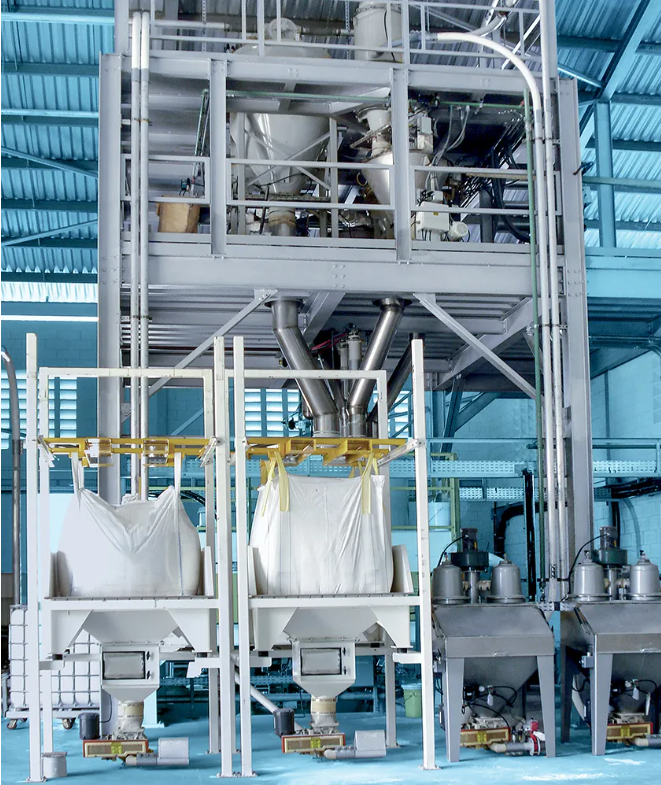
Process Control and Data Integration
As production complexity increases, automation control systems play an increasingly important role in ensuring repeatability and traceability. These systems can support:
Automated Material Handling and Inventory Management
Accurate formula execution
Monitoring of process parameters such as temperature and pressure
Data collection for quality assurance and compliance
In addition to improving efficiency, these tools also enhance process transparency and consistency, particularly suitable for regulated or high-performance applications.
Promote a systematic approach
The PVC production environment often faces challenges such as abrasive materials, space limitations, and the need to maintain operation during equipment upgrades. These factors further emphasize the importance of adopting systematic design and operation methods.
This method not only involves factory equipment, but also upstream factors such as procurement, transportation, and storage conditions. The implementation of consistency relies on collaboration in the following aspects:
Material characteristics and formula design
Supply Chain Volatility
Bulk material handling and feeding system
Process Automation and Control Strategy
A comprehensive system perspective helps improve reliability, reduce fluctuations, and achieve more predictable production performance.
Key Points
The upstream process has a significant impact on the final result: material handling, feeding, and pretreatment steps directly affect product quality.
Material characteristics should guide system design: changes in physical properties and the impact of supply chain conditions must be considered.
Integrated systems can enhance consistency: coordinating devices, control systems, and data management can help improve repeatability and operational stability.


