-
E-mail
mxq1901@163.com
-
Phone
18202661041
-
Address
Tianjin Wuqing Development Zone Entrepreneurship Headquarters Base
Product Categories
Tianjin Mengxiangyuan Technology Co., Ltd
Price of domestic optoelectronic comprehensive experimental platform
NegotiableUpdate on 01/17
- Model
- Nature of the Manufacturer
- Producers
- Product Category
- Place of Origin
Overview
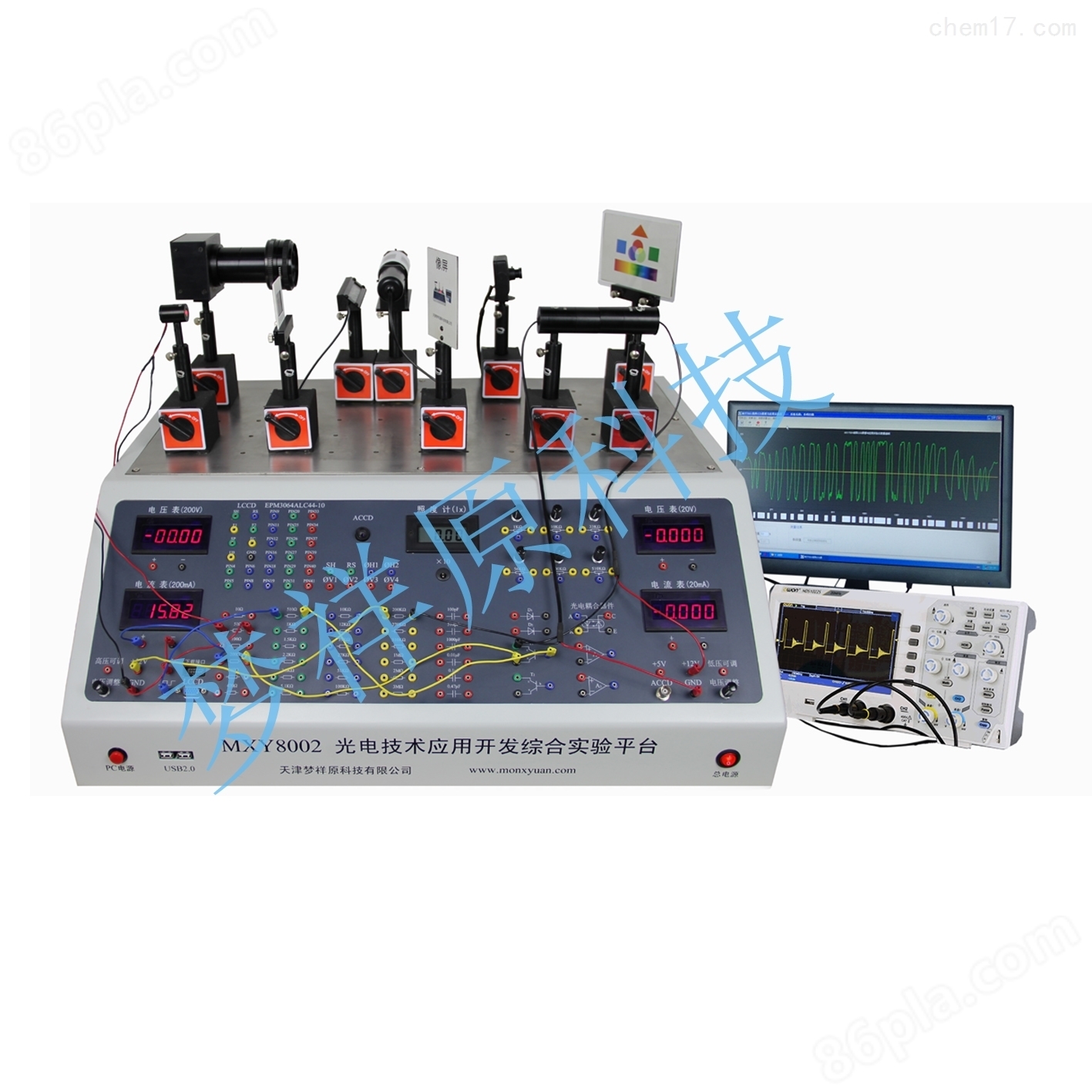
This optoelectronic comprehensive experimental platform is designed for the development of optoelectronic device applications. It consists of an optical platform, a digital instrument and electronic component platform, the principle and application of line/area array CCD cameras, data acquisition input and output ports, a computer system, and data acquisition software for line/area array CCD cameras. The platform is equipped with various power interfaces and 0-200V high-voltage adjustable power supply and 0-12V low-voltage adjustable power supply, which can provide power for students to build various experimental circuits.
Product Details
MXY8002 Comprehensive Experimental Platform for Optoelectronic Technology Application Development
1、 Product Introduction
MXY8002Optoelectronic comprehensive experimental platformDesigned for the development of optoelectronic device applications, the platform consists of optical platform, digital instrument and electronic component platform, principle and application of line/area array CCD camera, data acquisition input and output ports, computer system, line/area array CCD camera data acquisition software, etc. The platform is equipped with various power interfaces and 0-200V high-voltage adjustable power supply and 0-12V low-voltage adjustable power supply, which can provide power for students to build various experimental circuits. Students can use the platform to independently build various optical systems, photoelectric sensor conversion and processing circuits, complete various application development and design related to photoelectric technology, improve students' brain and hands-on ability and innovation awareness from all aspects, and help universities cultivate talents in photoelectric technology.
1. Optical platform
The optical platform is made of magnetic conductive material, which can be used to build geometric optics, physical optics, photoelectric detection and photoelectric control systems using magnetic bases, optical accessories and electronic components, and combined with the data acquisition system inside the instrument to complete various experimental systems.
2. Digital instrument and electronic component platform
The platform provides two digital voltmeters (four and a half digits), two digital ammeters (four and a half digits), and an automatic range changing digital illuminance meter, which can be used in circuits to measure various circuit parameters. This platform is also equipped with various resistors, capacitors, adjustable potentiometers, diodes, transistors, integrated operational amplifiers, optocouplers, and field programmable logic devices (CPLDs).
3. Principle and Application of Line/Area CCD Camera and Data Acquisition Input/Output Ports
The principle and application of installing wired/area array CCD cameras on the platform panel, as well as data acquisition input/output ports, form a complete data acquisition system with the data acquisition card of the line array CCD camera and the data acquisition card of the area array CCD image sensor inside the platform. It is connected to a computer through a USB bus to complete the development and design of various measurement, vibration, scanning, and image acquisition and processing software functions. The output port provides digital driving signals and analog output signals for line/area array cameras. Students can observe these signals through an oscilloscope to understand the working principle and application of line/area array CCDs, and then develop and design them through CPLD to improve their brainpower.
4. Computer functional software
The platform is equipped with various functional software, including linear CCD size measurement, angle measurement, displacement measurement, barcode recognition, image scanning software, surface CCD edge and contour detection, object size measurement, point operation of images, geometric transformation of images, image acquisition and parameter setting, projection and difference image analysis, image filtering and enhancement, morphological processing, rotation and scaling, color recognition and transformation and other image processing software. Not only does it provide DEMO demonstration software, but it also offers SDK software development kits for students to conduct secondary development.
Dimensions: 680mm (length) x 550mm (width) x 230mm (height) Weight: 25kg
2、 Teaching objectives
1. Understand and master the principles and applications of various optical components and their experiments;
2. Understand and master the working principles, conversion circuits, and processing circuits of various photoelectric sensors;
3. Understand and master the principle and application of linear CCD;
4. Understand and master the principle and application of area array CCD;
5. Understand the application development technology of CPLD;
6. Cultivate students' ability to use their brains and hands-on skills, as well as their innovative consciousness;
3、 Can complete the following experimental tasks:
Experimental Study on the Principles and Characteristics of Optoelectronic Sensor Devices
1. Experimental study on the spectral characteristics of light source emission;
2. Experimental measurement of photometric radiance parameters;
3. Characteristic parameters and measurement of photoresistors;
4. Voltage current characteristic experiment of photoresistor;
5. Conversion circuit of photoresistor;
6. Time response characteristics of photoresistors;
7. Measurement of Light Sensitivity of Photodiodes;
8. Measurement of volt ampere characteristics of photodiodes;
9. Measurement of time response characteristics of photodiodes;
10. Characteristic parameters and measurements of silicon photovoltaic cells under different bias states;
11. Measure the time response of silicon photovoltaic cells under reverse bias;
12. Measurement of Light Sensitivity of Phototransistors;
13. Measurement of volt ampere characteristics of phototransistors;
14. Measurement of time response of phototransistors;
15. Measurement of spectral characteristics of phototransistors;
16. Measurement of current transmission ratio of optocoupler;
17. Measurement of volt ampere characteristics of optocoupler devices;
18. Measurement of time corresponding to optoelectronic coupling devices;
19. Basic principle experiment of pyroelectric devices;
20. Experimental testing of spectral response of pyroelectric devices;
21. Measurement of characteristic parameters of PSD displacement sensor;
22. Avalanche photodiode (APD) characteristic experiment;
23. PIN photodiode characteristic experiment;
24. Four quadrant photoelectric sensing characteristic experiment;
25. Measurement of anode dark current Id of photomultiplier tube;
26. The relationship between the sensitivity Sa of the photomultiplier tube and the power supply voltage Ubb;
27. Measurement of current gain G of photomultiplier tube;
28. Measure the forward voltage of LED;
29. Measure the reverse voltage of LED;
30. Measure the forward working current of the LED;
31. Measure the reverse working current of the LED;
32. Measure the angle of the semi luminous intensity of the luminescent light source;
33. Measure the deviation angle between the central axis of the luminescent light source and the mechanical axis;
34. Measure the emission spectrum of LED;
35. Measure the emission spectrum of LD semiconductor lasers;
Experiment on Optoelectronic Detection Technology
1. Principle and driving experiment of linear CCD;
2. Linear CCD size measurement experiment;
3. Linear CCD angle measurement experiment;
4. Using linear CCD to recognize barcodes;
5. Using a linear CCD to measure the position and vibration of an object;
6. Using linear CCD for object scanning;
7. Grating and Moir é fringe experiment;
8. Measurement using Fraunhofer diffraction;
9. Principle and driving experiment of area array CCD;
10. Using a surface array CCD to measure the external dimensions of an object;
11. Extracting edges and contours of objects using a surface array CCD;
12. Using area array CCD for image acquisition and parameter setting;
13. Using area array CCD for projection and subtraction image analysis;
14. Using area array CCD for image filtering and enhancement;
15. Using area array CCD for morphological processing;
16. Using area array CCD for object rotation and scaling;
17. Using area array CCD for color recognition;
18. Using area array CCD for point operation of image information;
19. Using area array CCD for geometric transformation of images;
20. Conduct data acquisition experiments using a surface array CCD;
Modern Optical Experiment
1. Measure the focal length of a thin convex lens using a telecentric illumination light source;
2. Measuring the focal length of a thin convex lens using displacement method;
3. Assemble microscope system;
4. Assemble a transmissive slide projector;
5. Principle and phenomenon of double slit interference;
6. The principle and phenomenon of Fraunhofer single slit diffraction;
7. The principle and phenomenon of Fraunhofer circular hole diffraction;
8. Using Fraunhofer diffraction to measure the diameter of fine filaments;
9. Polarization experiment of light;
Experiments on CPLD application technology
1. Write and design clock logic circuit experiments;
2. Write and design a 2160 pixel linear array CCD driving circuit experiment;
3. Write and design the logic circuit of a linear CCD binary data acquisition system;
4. Develop and design a system for measuring the number of workpieces passing through a certain workstation on an assembly line;
4Optoelectronic comprehensive experimental platformSupporting documents and materials
1. One experimental guidebook;
2. Software: Platform software and hardware user manuals, etc;
Similar Product Recommend