-
Phone
13676799385
-
Address
No. 8 Linpu Road, Zhangbao Industrial Zone, Oubei Town, Yongjia County, Zhejiang Province
Product Categories
Yongjia County Marine Water Pump Factory

JB-70 refueling (electric) hand pump
NegotiableUpdate on 09/20
- Model
- Nature of the Manufacturer
- Producers
- Product Category
- Place of Origin
Overview
The JB-70 electric and hand cranked dual-purpose metering fuel pump is suitable for small and medium-sized oil main refueling stations, gas stations, agricultural machinery stations, supply and marketing cooperatives, enterprise factories, mining fleets, vehicles, ships and other units in various places to suck and deliver various fuels such as gasoline, diesel, kerosene, engine oil, food oil, etc. The device has the advantages of compact structure, reliable quality, stable performance, and easy mobility. It is equipped with an explosion-proof motor and a 25mm flowmeter. When there is a power supply, it can be refueled electrically, and when there is no power supply, it can be manually refueled. The measurement is accurate and there is no zero return device.
Product Details
Product Overview
The JB-70 refueling (electric) hand pump is suitable for small and medium-sized oil main refueling stations, gas stations, agricultural machinery stations, supply and marketing cooperatives, enterprise and mining fleets, vehicles, ships and other units to suck and deliver various fuels such as gasoline, diesel, kerosene, engine oil, food oil, etc. The device has the advantages of compact structure, reliable quality, stable performance, and easy mobility. It is equipped with an explosion-proof motor and a 25mm flowmeter. When there is a power supply, it can be refueled electrically, and when there is no power supply, it can be manually refueled. The measurement is accurate and there is no zero return device.
parameter range
1. Model: Vertical dual-purpose metering electric pump
2. Allowable suction range: ≤ 4-5m
3. Work pressure: 0.25MPa
4. Flow range: 25-60L/min Flow rate: 60-80
5. Regulated flow range error: ± 2% (Level 2) ± 1% (Level 1)
6. Inlet nominal diameter: 25mm
7. Motor: Explosion proof three-phase asynchronous motor 0.8KW
8. Motor power supply voltage: 380V 50HZ
9.1 Flow meter LXYL-25 rotary flow meter (indication error ± 2%)
9.2 Flow meter: LY-25 spiral wing flow meter (indication error ± 1%)
10. Transmission method: V-belt pulley transmission V-belt A-type 1168mm
11. Dimensions: 51X41X54 12, Weight of the whole machine: 55KG
Characteristics and Applications
The JB-70 refueling (electric) hand pump is a blade type pump with an overflow valve device. When the oil tank is filled with oil and the oil gun needs to be closed, the blade pump can continue to work. When the oil pressure exceeds the rated pressure, the overflow valve in the pump will automatically return the oil to the oil tank or reservoir.
working principle
Rotate the explosion-proof switch knob 1 to the "ON" position on the on/off indicator, and the explosion-proof motor 2 drives the vane pump 6 to work through the triangular pulley 4. The oil flows from the oil tank (or oil drum), passes through the oil pipe 11 and filter 12, and is sucked into the vane pump chamber through the inlet hole of the vane pump. After passing through the oil hole of the vane pump, the oil is pressed into the flow meter 8 for automatic counting and measurement, and flows into the oil gun through the oil outlet pipe 10. When the handle of the oil gun is tightened, the oil automatically flows out and is injected into the container. Release the handle to stop the oil from flowing out.
When the rubber of the oil gun is closed and the motor still drives the vane pump to work, the oil pressure inside the vane pump will increase accordingly. To prevent damage to the components, once the oil pressure exceeds the rated pressure, the overflow valve inside the pump will automatically work, and the oil in the pump cavity will flow back to the oil tank (or oil tank) through the inlet hole of the vane pump and the oil pipe.
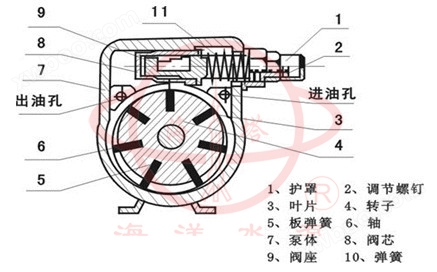 |
structural diagram
performance parameters |
model |
Inlet and outlet diameter mm |
Flow range L/min |
Suction distance m |
Head m |
Measurement accuracy% |
Motor power KW |
voltage |
Weight Kg |
Accumulated count range |
25 |
JB-70 |
5 |
25 |
55~65 |
0.75 |
380 |
75 |
999 |
±1
Maintenance and Care
1. Regularly check the smoothness of the oil flow in the vane pump, flow meter, oil gun, and pipeline. If it is not smooth, the cause should be promptly identified and repaired.
2. Regularly maintain the cleanliness of the conductive rubber wheel and prevent any dirt from covering the insulation.
3. When moving or repairing this machine, the power should be cut off and the explosion-proof switch knob should be turned to the "straw stop position" to avoid unsafe accidents caused by live operation.
4. The oil inlet pipe filter should be checked and cleaned regularly. When cleaning, loosen the screws of the pipe box to remove the filter screen. Be careful not to break the filter screen during cleaning. If the filter screen is already broken, it should be replaced in a timely manner.
5. The whole machine has worked for 500 hours, and the blade pump, oil gun, pipeline, etc. should be disassembled, inspected, and cleaned.
6. To simplify the structure, this machine does not come with lighting fixtures. If users need to observe the counter numbers, they should equip themselves with explosion-proof lights and strictly use ordinary lighting fixtures and flashlights.
Operation and usage
1. Operating procedures
(1) Connect the power and turn the explosion-proof motor knob to the "ON" position.
(2) Tighten the plate and pinch the oil gun to dispense oil, and the flow meter will start counting at the same time.
(3) Release the oil discharge handle to stop the oil discharge, and the count value is the amount of oil added (or the difference between the two readings before and after is the amount of oil added)
(4) When stopping work, the explosion-proof motor knob should be turned to the "OFF" position first, then the power switch should be cut off, and the rubber sleeve cable should be wound properly.
2. Usage precautions
(1) For refueling machines that have been transported over long distances or have been unused for a long time, the insulation resistance of the motor must be measured with a 50 year old megohm meter before use, and the value should not be less than 10 megohms.
(2) Before the whole machine starts working, check whether the motor rotation is correct (facing the triangular pulley, it should rotate clockwise).
(3) The duration for the oil gun to turn off the motor and still drive the vane pump to suck oil should generally not exceed one minute.
(4) To maintain normal oil output efficiency and pressure, the regulating screw of the overflow valve on the vane pump can be used to adjust the pressure of the oil circuit.
(5) Push the copper cap on one side of the counter on the flowmeter inward, (referring to the 1st stage) 2nd stage flowmeter. After each indication is complete, rotate the handwheel counterclockwise and set the size pointer back to zero. The pointer of the counting disk will automatically return to zero. If continuous counting is required, the copper cap will no longer be pressed.
(6) Control the tightness of the oil gun pinch plate, which can roughly adjust the oil output.
(7) The rubber sleeve cable of this machine should avoid wear and tear with the ground and its objects during use. It is strictly prohibited to run it over with a foot pedal. The integrity of the rubber sleeve should be checked regularly during use.
(8) Oil inlet and outlet pipes, oil outlet guns, and cables should be wound around designated positions when not in use, and should not be dragged anywhere. Before inserting the oil inlet pipe into the oil tank (or oil drum), it should be cleaned thoroughly.
(9) Before connecting the rubber sheathed cable to the power supply, it is necessary to identify the grounding wire and phase wire (measured with a multimeter). The grounding wire should be reliably connected to the motor casing and ground.
(10) Do not use nylon or plastic pipes that are prone to generating and accumulating a large amount of static electricity to replace the specialized inlet and outlet oil pipes of this machine for refueling.
(11) Ordinary cables shall not be used to replace the special rubber sheathed cables of this machine, nor shall they be randomly disassembled and connected.
(12) Operators are strictly prohibited from wearing synthetic clothing for refueling operations and should comply with relevant safety operation regulations in the petroleum and chemical industry
Similar Product Recommend


