-
E-mail
tech@i-can.com.cn
-
Phone
13718758268
-
Address
No. 609, Block B, Yuhui Building, No. 73 Fucheng Road, Haidian District, Beijing
Product Categories
Beijing Aikang Air Treatment System Co., Ltd
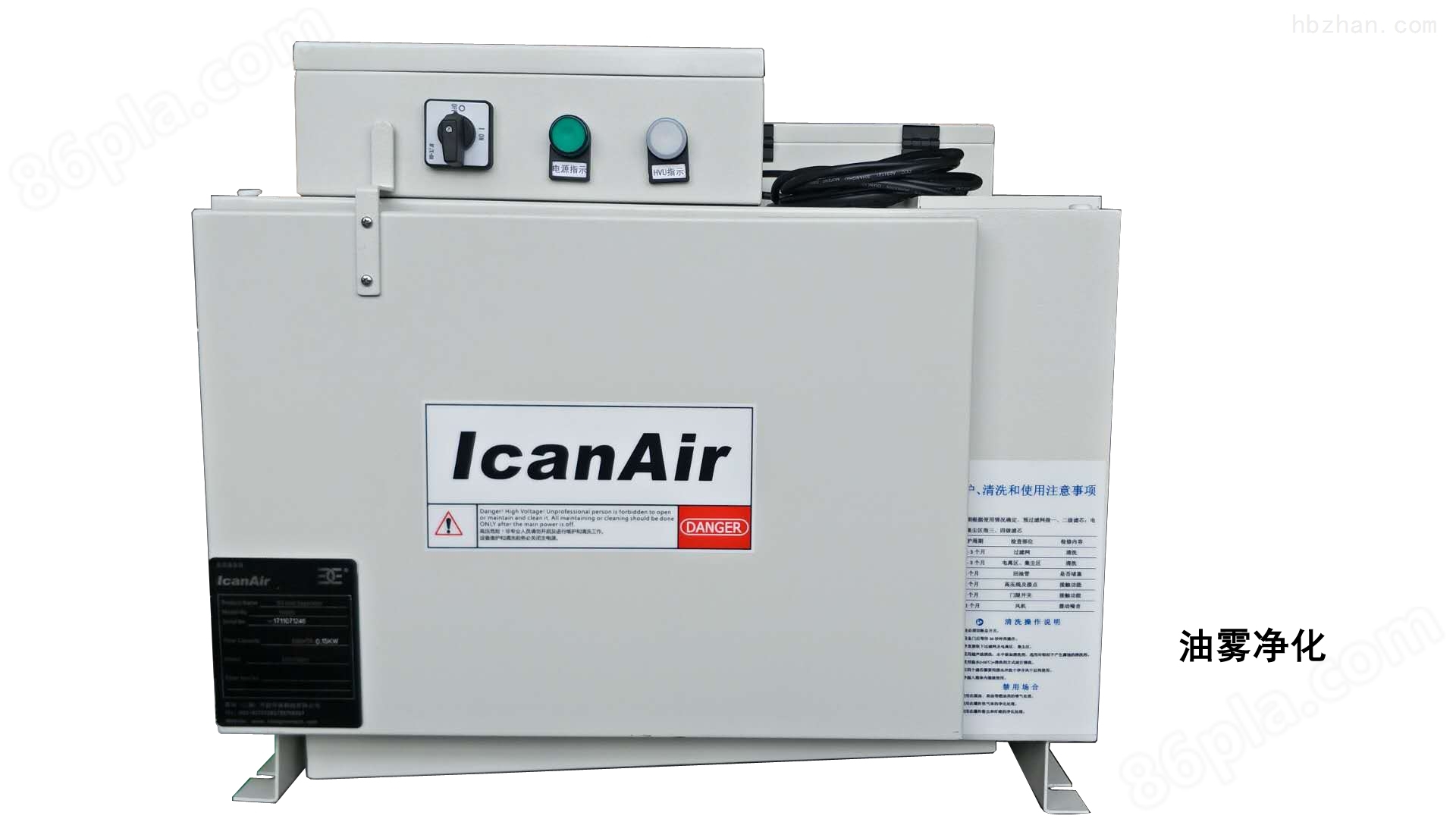
Beijing oil mist purification selection
NegotiableUpdate on 01/17
- Model
- Nature of the Manufacturer
- Producers
- Product Category
- Place of Origin
Overview
Oil mist purifier is an industrial environmental protection equipment. Installed on mechanical processing equipment such as machine tools and cleaning machines, it absorbs oil mist from the processing chamber to purify the air and protect the health of workers.
Product Details
oil mist purification
The existence form of oil mist
The metal cutting process can generate the following three types of oil mist:
(1) Clean oil mist generated by jet impact, free of solid dust;
(2) Smoke generated due to evaporation or burning caused by high temperature during heating or high-speed cutting;
(3) The oil mist containing grinding dust generated by the spraying of metal cutting fluid during grinding.
The way oil mist is generated varies, and the range of particle diameters also differs significantly. In general, the oil mist generated during the mechanical atomization process mainly exists in the form of liquid droplets, with a wide range of droplet diameters, usually 2-10um. The oil vapor generated by evaporation also forms a very small diameter condensation suspension during the condensation process, with a particle size usually below 2um. Medical research has shown that oil vapor and large droplets pose relatively little harm to the human lungs. Oil mist in the form of oil vapor is inhaled into the lungs and exhaled, but it is not captured by the alveoli, and large oil droplets cannot enter the lungs through the nose and bronchi. Only oil mist particles in the form of droplets with a diameter less than 5um can smoothly reach the alveoli and settle in the lungs, causing significant harm to the human body
According to the principle of principal mechanics, when larger oil droplets in an oil mist collide and settle downwards under the action of gravity, fine aerosol particles undergo thermal motion with the centrifugal force of the airflow. Random particles move from high concentration areas to low concentration areas, and under the action of tangential force, high concentration oil mist is pulled back by negative pressure in the vortex area of the airflow and captured. Low concentration oil mist is rectified, intercepted, and diffused by continuous and discontinuous processing units before condensing into a liquid state and returning to the collection tank for reuse. The continuously processed oil mist gas is subjected to VanderWaals forces and is discharged as clean gas at the terminal.